

How it works
Each skill does one job and then hands over. A skill’s Hand-offs section names where the work goes next. Together they form one loop: see the problem, fix the cause, hold the gain.
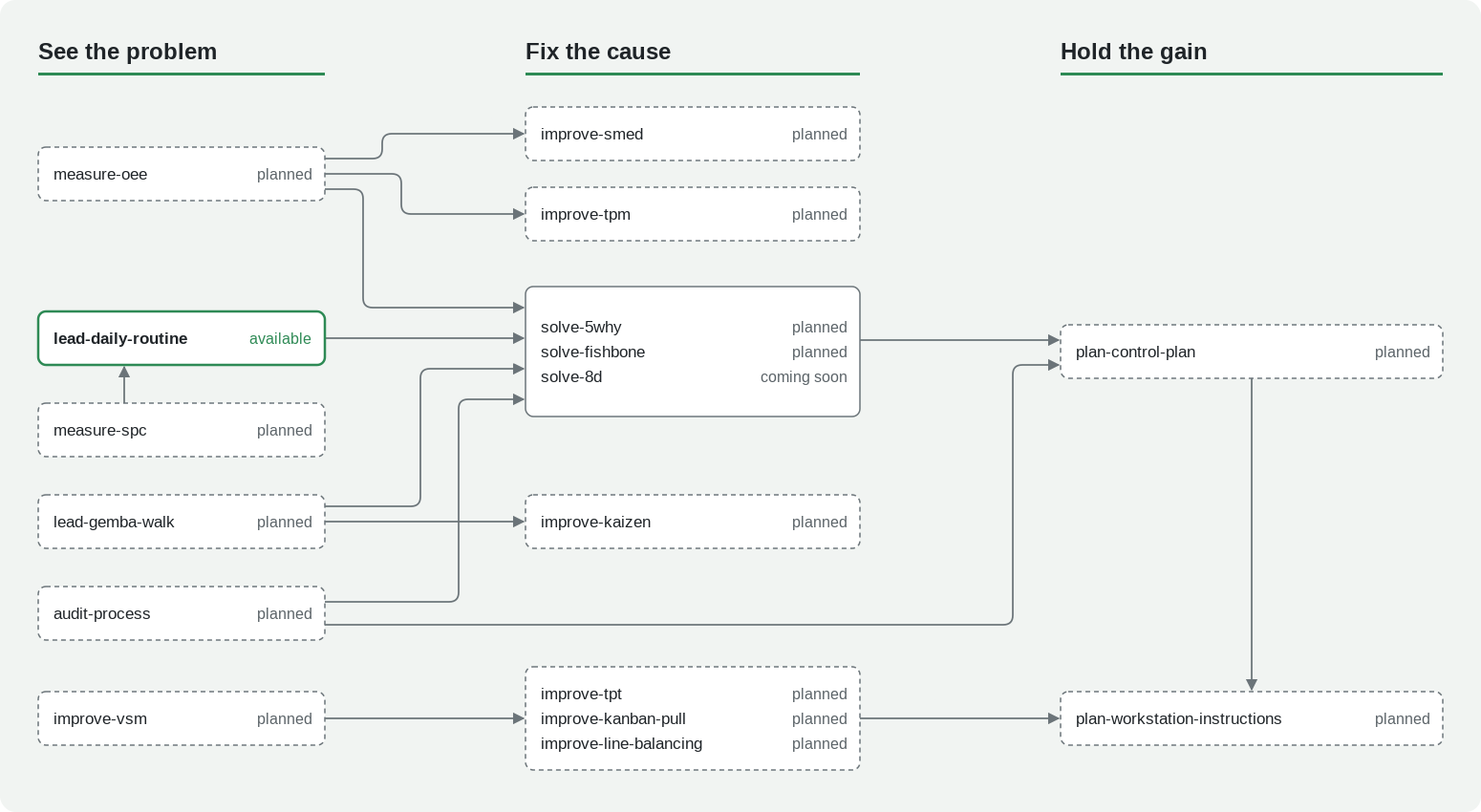
Today only lead-daily-routine is available, and solve-8d is coming soon. The other boxes are planned skills, drawn with a dashed border.
The hand-offs
Section titled “The hand-offs”| From | When | To |
|---|---|---|
lead-daily-routine |
A KPI is red and the cause is unknown | solve-5why, solve-fishbone or solve-8d |
measure-spc |
A process is out of control | Escalation in lead-daily-routine |
measure-oee |
The loss tree shows set-up loss | improve-smed |
measure-oee |
The loss tree shows breakdowns | improve-tpm |
measure-oee |
The loss tree shows defects | the solve skills |
lead-gemba-walk |
Observations | improve-kaizen or the solve skills |
audit-process |
Findings | the solve skills or plan-control-plan |
improve-vsm |
The future state needs one part fixed | improve-tpt, improve-kanban-pull or improve-line-balancing |
| the solve skills | The root cause is fixed | plan-control-plan, to update it |
plan-control-plan |
The control plan changed | plan-workstation-instructions |
| the flow skills | A new standard work exists | plan-workstation-instructions |
Why a loop
Section titled “Why a loop”A fix that never reaches the control plan and the station instruction is lost at the next shift change. So every path through the loop ends in the documents that the line works from. The daily routine then watches the new standard, and a new red starts the loop again.
Rules that keep the loop honest
Section titled “Rules that keep the loop honest”- A skill names only skills that already exist. The linter checks every name, so a hand-off to a planned skill is added in the same change that adds that skill.
- Until then, a skill describes the next step in words. For example,
lead-daily-routinesays to start an 8D outside the meeting and track it on the action list.